Virtual Walk and Talk Therapy Could Be a Game Changer for BIPOC Clients in Florida
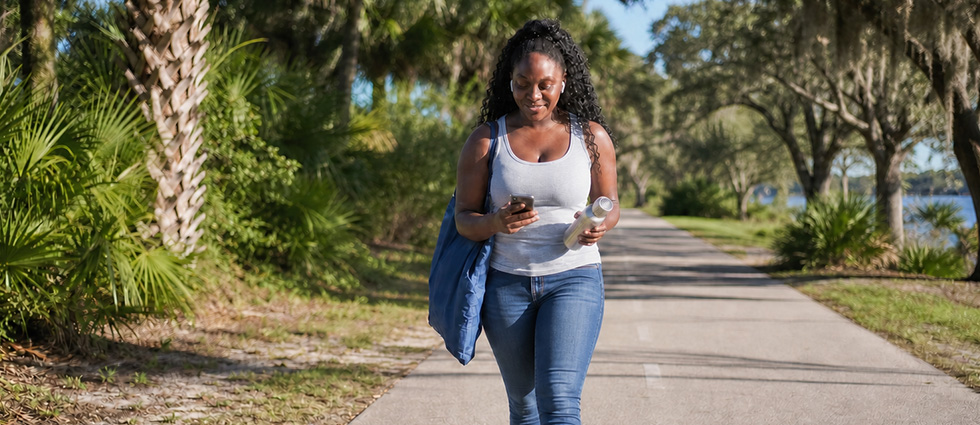
Virtual walk and talk therapy removes many of the biggest barriers BIPOC clients face in traditional therapy, like the institutional setting that keeps your nervous system on guard, the surveillance dynamic that makes it hard to relax and unmask, or the feeling of being in an interrogation room that so many describe. When those barriers are lowered, the actual work of healing becomes possible. Not easier, but possible.
For BIPOC clients in particular, virtual walk and talk therapy changes not just where therapy happens, but whether it can happen at all.
You’re Not Overreacting. Your Body Knows What It’s Been Through.
Here’s something that doesn’t get said enough in clinical settings: if traditional therapy has felt harder than it should, your body has probably been right about something.
The clinical gaze has never been neutral.
Sitting across from a therapist in a formal office setting can activate a social surveillance response that your nervous system already knows too well. For BIPOC clients navigating predominantly white professional spaces, that kind of monitoring is a daily reality, and your body responds:
- Jaw tension, shallow breathing
- The constant background scan of the room for subtle signals about how you’re being read
- Managing your language, your expressions, and the way you frame your experiences so they land correctly
Code-switching is exhausting enough at work. Doing it in therapy, too, leaves you less capacity for the actual work.
The tension you’re feeling isn’t resistance to therapy. It’s a recognized clinical pattern.
Race-Based Traumatic Stress, first articulated by Robert T. Carter in 2007, establishes that cumulative racial encounters — microaggressions, institutional bias, the hypervigilance required to navigate spaces that weren’t designed for you — produce trauma responses that look a lot like PTSD. Intrusion, avoidance, hyperarousal. Stored in the body, not just the mind.
Virtual walk and talk therapy changes the equation. When your body is moving, and the clinical room is gone, something shifts that allows the real work to begin.
Two Specific Things Change When You Move (And Why It’s Not Just About Emotional Comfort)
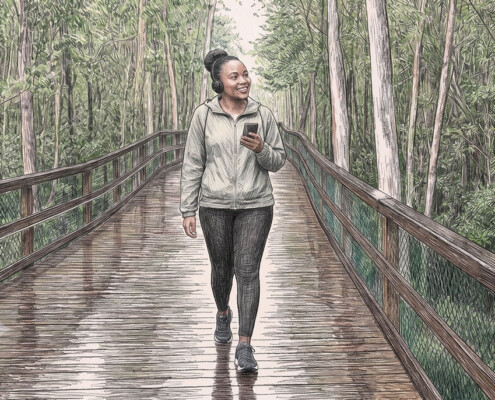 In a world where every meeting, call, and check-in happens on a screen, virtual walk and talk therapy might be the only hour in your week where you don’t have to think about meeting anyone’s eyes, and nobody is watching your face.
And when you walk outside in a safe environment, two remarkable things happen.
1) The bilateral movement does clinical work.
When you’re walking, something measurable happens in your nervous system.
Walking’s left-right rhythm activates the nervous system in ways that parallel what happens in EMDR. It keeps working memory engaged just enough that difficult material becomes easier to access without flooding over you. Your body is busy walking, which means the stored tension of chronic stress has a physical pathway out, rather than settling in while you revisit painful memories.
2) The environment itself is doing something too.
When your eyes shift from a focused, narrow gaze to taking in a wider field like the trees at the edge of the path, the sky, and the ambient movement of the world around you, your brain receives a bottom-up signal that the environment is safe.
- Amygdala activation drops (your threat response quiets down)
- Cortisol begins to fall (your stress hormones follow)
- Most people feel that shift happen within minutes of moving into open space
The workplace is a minefield, microaggressions accumulate, and racial stress is genuinely physiological. Your nervous system has been running at an elevated baseline. The reset being in a different environment isn’t a nice-to-have. It’s often what makes the session possible at all.
The Numbers in Florida Tell a Story About BIPOC Health Care
If you’ve ever felt like therapy wasn’t built for you, the data supports your instinct.
1) Access is already broken in Florida.
- Florida ranks 49th out of 51 states for access to mental health care [1]
- Roughly 63.5% of Florida adults with a mental health condition receive no treatment — close to three million people [2]
- Nationally, Black, Hispanic, and Asian adults access mental health services at rates between 33% and 44%, compared to 58% for white adults [3]
2) Representation in the workforce is a crisis.
- Only 5% of the active psychology workforce in the United States identifies as Black or African American [4]
- In Florida, 10 out of 11 psychology training programs graduated fewer than 7% Black students over a recent three-year period — in a state where nearly 1 in 5 people aged 20 to 35 is Black [5]
- 50% of reported reasons for unmet mental health needs in BIPOC communities are structural: scheduling, transportation, and inability to take time off work [6]
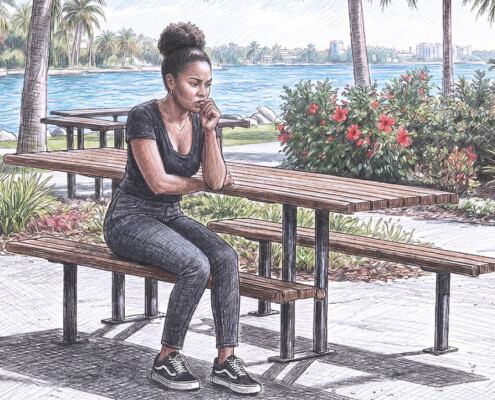
Given that the numbers confirm what you already knew, distrust is a reasonable and historically earned response to a healthcare system with a record of misdiagnosis, dismissal, and institutional harm.
Receiving therapy in an environment that works for your nervous system, even if it doesn’t look traditional, is a genuinely different kind of care.
Learn more about virtual how walk and talk therapy works and book an appointment with an expert therapist.
What a Virtual Walk and Talk Session Actually Looks Like
There’s no commute, no waiting room, no clinical chair.
You start from wherever you are, whether that’s from your front door, a park bench, or even getting some cool AC while “mall walking” in the Florida heat. You put in your earbuds. Your therapist’s voice stays private. To anyone who passes you, you’re just on a phone call. And isn’t everyone these days? You won’t stand out.
Your therapist reads where you are before you start.
If you’re in the middle of something heavy like actively processing grief, working through something that might take you somewhere raw, our experienced clinicians will adjust the session and perhaps suggest a different route or format for that day. The modality adapts to you, not the other way around.
Your privacy is more manageable than it sounds.
- Your voice doesn’t carry as far as you think it does
- Without your therapist’s responses audible, you sound like exactly what you are: someone on a phone call
- Routes, timing, and pace are something you work out together, with privacy in mind
“Being considered the strong one does not mean that they do not struggle as well, does not mean that they are always okay.”
— Kaydianne Fletcher, Therapist | True You Always
Why Choose True You Always for Virtual Walk and Talk Therapy in Florida?
True You Always is a telehealth-first practice, which means your therapist doesn’t have to live nearby. We believe that finding a clinician who “gets you” shouldn’t be limited by your zip code. You can walk your neighborhood in Miami, Jacksonville, Tampa Bay, or Brevard County while your clinician joins from another part of Florida.
As well as being untethered by geography (within Florida), our clinicians understand that racial stress, overfunctioning in systems not built for you, and the exhaustion from code-switching aren’t symptoms of a fragile personality. They’re the predictable response to your ongoing structural reality. Therapy here doesn’t ask you to explain why that’s hard. It starts from the assumption that it is.
“No more explanations, no more trying to dumb it down. I’m here to heal.”
— Vernitta McQueen | True You Always Therapist
Frequently Asked Questions
About Virtual Walk and Talk Therapy
I feel uneasy talking about racism and stress. Is talking about that outside really safe?
Yes. Your therapist’s voice stays in your earbuds, so no one around you hears their side of the conversation, and at a normal speaking volume you sound like anyone else on a phone call. Before your first virtual walk and talk therapy session, you and your therapist plan routes, times, and a simple “pause” protocol so you can go quiet or shift topics if someone passes.
What if I run into someone I know?
From the outside, you look like someone on a phone call, which is what everyone else is doing too. A simple “Hey, I’m on a call, let’s catch up later” is usually enough, and your therapist will immediately follow your lead and pause until you’re ready to continue.
I really hate the thought of sitting in a therapy room. How is this actually different?
Traditional therapy rooms can keep your nervous system on guard—watching the walls, the clock, the therapist’s face, and worrying about how you’re coming across. In virtual walk and talk therapy, you’re moving through your own environment, so walking, a wider field of view, and less forced eye contact give your body a chance to downshift, which makes the real work of therapy more possible.
Okay, I’m intrigued — but is Virtual Walk and Talk Therapy just a new-age fad?
No. Virtual walk and talk therapy isn’t a trend we invented for marketing; it’s part of a much longer line of research on what happens to your nervous system when you combine movement, nature, and therapy. Walk-and-talk and outdoor therapies have been studied for years, and the evidence shows that walking in natural environments can lower stress hormones, quiet threat responses, and help people access difficult material without getting overwhelmed—especially when sessions are structured by a trained clinician.
Where can I learn more about Virtual Walk and Talk Therapy at True You Always?
If you want the big-picture explanation of how virtual walk and talk therapy works, why we take therapy outside, and how it supports your nervous system, you can learn more here: Walk and Talk Therapy in Florida : Virtual and In-Person. You can also explore more Frequently Asked Questions about safety, privacy, tech setup, getting started, the therapeutic process, understanding credentials, and what to expect.
Are You Ready to Stop Sitting With the Idea of Therapy?
Take the Next Step Today
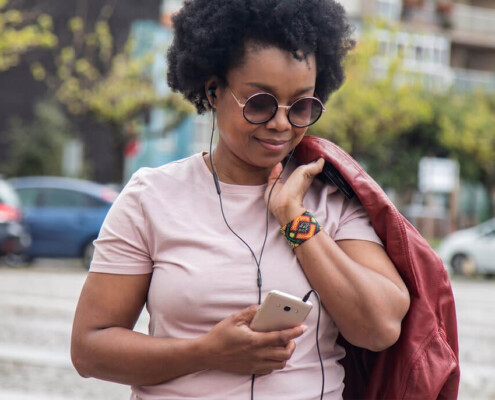
If everything about therapy has just felt too hard, virtual walk and talk therapy might be the thing that finally makes it possible. Not because the work of therapy is any easier. But because the movement removes so many barriers your nervous system is complaining about.
Learn more and book an appointment for Virtual Walk and Talk Therapy or meet our therapists to find someone who feels like the right fit.
True You Always is a telehealth-first practice providing virtual walk and talk therapy across Florida. Our clinicians are based in Merritt Island, Melbourne, Palm Bay, Orlando, and Coconut Creek, serving clients throughout Brevard County and across Florida’s major metros — Tampa Bay, Miami, Fort Lauderdale, and Jacksonville.
Clinically reviewed by: Amber Hartnett, MSW, LCSW-QS, MCAP, CEDS-C, Founder & CEO, True You Always
Published: June 19, 2026 | Last Reviewed: June 2026
This page is informational and not a crisis service. If you are in immediate danger or experiencing a mental health emergency, please call or text 988 or 911, go to your nearest emergency room, or text HOME to 741741 to connect with the Crisis Text Line.
The Data We Referenced
[1] Florida Mental Health Access Ranking (49th out of 51)
Source: The Journal of Behavioral Health Services & Research / Mental Health America
URL:https://pmc.ncbi.nlm.nih.gov/articles/PMC9812544/
[2] Untreated Mental Illness in Florida (63.5%)
Source: The Journal of Behavioral Health Services & Research / Mental Health America
URL:https://pmc.ncbi.nlm.nih.gov/articles/PMC9812544/
[3] Disparities in Mental Health Care Utilization (Black 38.5%, Hispanic 44.1%, Asian 32.5% vs White 57.9%)
Source: Substance Abuse and Mental Health Services Administration (SAMHSA)
URL:https://www.samhsa.gov/data/sites/default/files/reports/rpt56771/2024-nsduh-psr7-mhtx-adult-adol.pdf
[4] National Lack of Diversity in the Psychology Workforce (5% Black)
Source: American Psychological Association / Mental Health America
URL:https://mhanational.org/resources/african-mental-health-quick-facts/
[5] Black Psychology Student Pipeline Bottlenecks in Florida (< 7% Black)
Source: George Washington University Health Workforce Institute
URL:(https://gwhwi.org/wp-content/uploads/2025/06/The-Race-and-Ethnicity-of-the-Florida-Health-Workforce.pdf)
[6] Structural Access Barriers to Care (50% of unmet needs are structural)
Source: All4HealthFL Collaborative / The Foundation for a Healthy St. Petersburg
URL:https://healthystpete.foundation/news/bipoc-mental-health-scan-summary/