In-Person Walk and Talk Therapy in Melbourne, Florida

Movement-Based Somatic Care

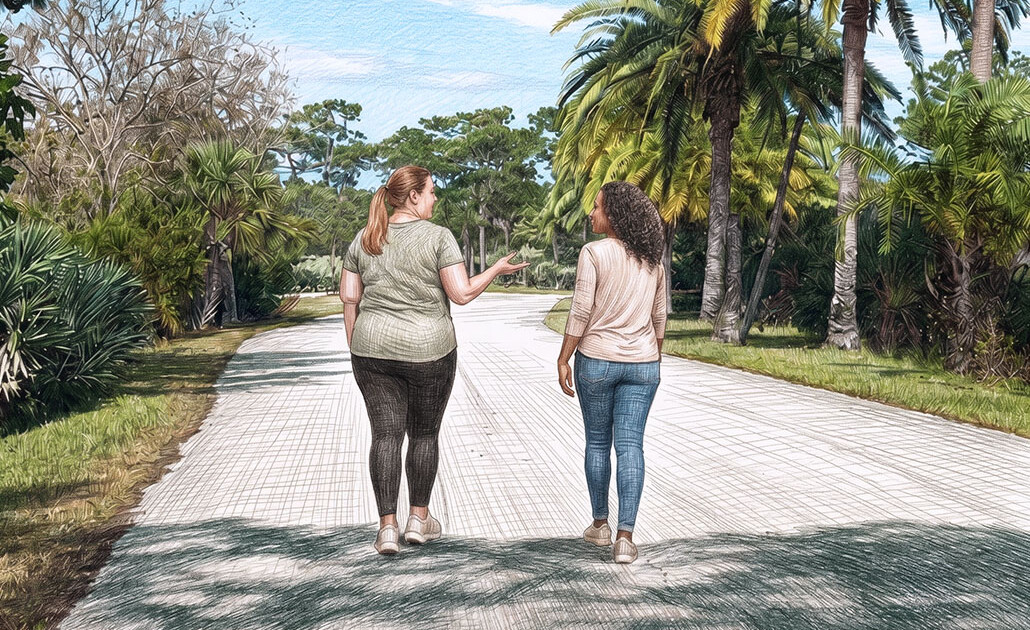
Illustration of an in-person walk and talk therapy session at Wickham Park in Melbourne, Florida.

In-Person
Walk and Talk Therapy
in Melbourne, Florida

Movement-Based Somatic Care
We know not everyone feels comfortable opening up in traditional therapy. The clinician’s gaze and the quiet room can feel a little intense. And if you’ve ever felt relief to leave a session instead of relief from what’s troubling you, the format may be part of the problem.

Walk and talk therapy moves sessions out of the therapy room and into a natural environment. The gentle walking, the rhythm of your pace, and the way your eyes follow what is ahead of you is a genuinely different way to help process trauma, anxiety, and sensory overwhelm.

At True You Always, we offer both virtual and side‑by‑side walk and talk therapy. The choice between the two often comes down to Florida weather, logistics, and what you feel comfortable with that week. Both formats give you different ways to break patterns you’ve been stuck in, especially patterns that have felt impossible to shift inside the therapy room.

Clinically reviewed by Amber Hartnett, MSW, LCSW-QS, MCAP, CEDS, Founder & CEO, True You Always
Last Reviewed: July 20, 2026

Why Walking Changes What Therapy Can Do

Walking while you talk doesn’t just change the scenery. It changes how you feel before you even start the session. Breathing fresh air and feeling the ground beneath your feet can calm that keyed‑up, on‑edge feeling.

Walk and talk therapy can be the difference between an anxiety‑filled hour that exhausts you and a session where you’re present in the moment, able to look at what’s happening in your life with more clarity.

Some of the benefits you might notice:

  • Less tension in your body. Walking can ease that restless, keyed‑up feeling that makes it hard to settle in traditional sessions.
  • Easier, more honest conversations. Facing forward instead of face‑to‑face often makes it simpler to say what feels hardest to say.
  • Fewer “stuck” sessions. Being in motion can help you move past repeating the same stories and into what’s really going on underneath.
  • A wider sense of perspective. Seeing beyond four walls can loosen the tight focus on “me and my problems” and open up new ways of looking at your situation.

Many Melbourne Clients Choose
In-Person Walk and Talk Therapy

True You Always offers both virtual and in-person walk and talk therapy in Melbourne.  If you live or work here, you can enjoy some of the benefits of in-person sessions where the therapist meets you on a shared outdoor trail or park path.

  • No Technology Disruptions

    In‑person walks completely sidestep video and phone glitches. There’s no worrying about dropped connections, frozen screens, or audio cutting out. You can stay with the conversation and the environment instead of troubleshooting devices.

  • Shared grounding in the same space.

    When you’re walking together, your therapist can use simple, body‑based grounding tools in real time. If you start to feel highly anxious, they can slow the pace, pause with you, or invite you to notice specific things around you—the wind in the trees, birdsong, shade, or open space. Paying attention to the same cues can help your nervous system settle. (Psychology Today)

  • A softer power dynamic

    Walking shoulder‑to‑shoulder on the same path often feels different than sitting across from someone in a room. Many people describe in‑person walks as feeling more like “we’re in this together” than “I’m being observed,” which can build trust more quickly, especially for teens, men, or anyone who feels resistant to traditional clinical settings. (APA)

Having a therapist physically present on the trail can make it easier to relax into the experience. When you’re sharing the same environment, you notice the same sounds and sights, and are pacing the session together instead of meeting through a device.

If you spend most of your days inside offices, on calls, or in high-pressure workplaces around L3Harris, Northrop Grumman, or Embraer, stepping into real space with another person whose focus is your wellbeing is a strong shift from other daily conversations.

The combination of movement, fresh air, and a therapist beside you often creates a kind of relief that’s hard to access indoors.

We also offer telehealth walk and talk therapy for days when in-person isn’t workable, whether that’s because of weather, health, mobility, or schedule. You might walk a familiar route near your home or office while your clinician joins you by phone.

You can use a mix of both formats, choosing what makes the most sense for your body and your life each week.

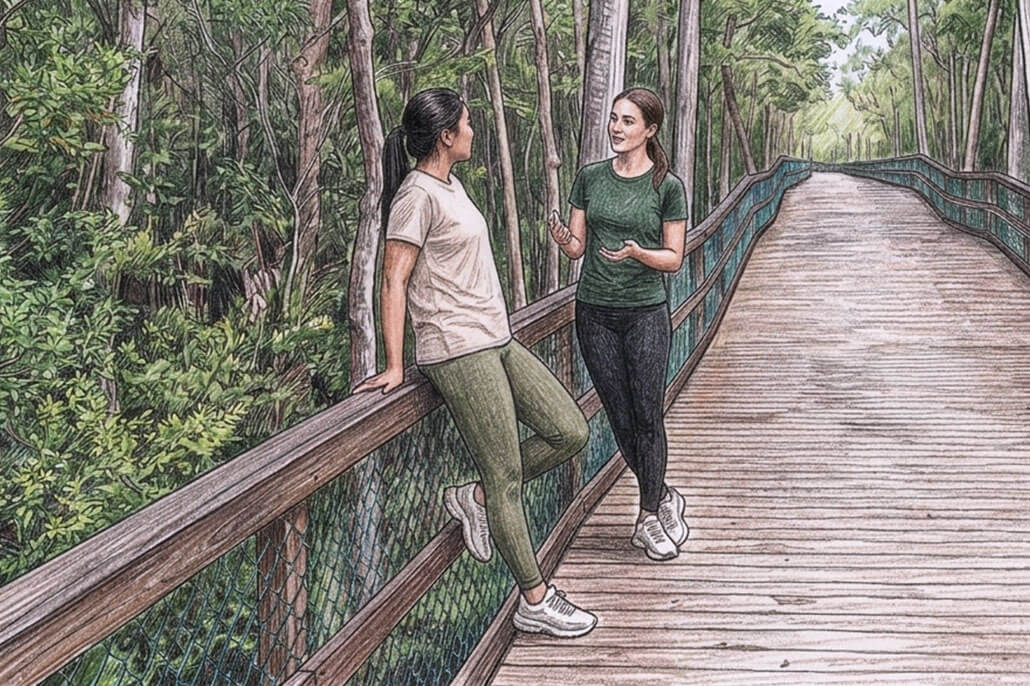
An artistic illustration of a therapist and client during walk and talk therapy. They are leaning against the railing of a wooden boardwalk, surrounded by dense green forest in Melbourne, FL

Illustration of a therapist and client during a walk and talk therapy session. They are leaning against the railing of a wooden boardwalk surrounded by dense green forest in Melbourne, Florida

Relaxing Paths in Melbourne, FL

You and your therapist will decide together which route makes the most sense for your body, your schedule, and your comfort level before you take a single step.

Melbourne, FL, offers a range of walkable environments, from quiet natural trails with dense tree cover and minimal foot traffic to wide, paved paths that feel open, predictable, and easy to navigate. Some clients feel safest in enclosed, shaded spaces with fewer people, while others prefer visible, structured routes where they can see what’s ahead. We’ll choose a setting that supports your nervous system throughout the session.

  • Turkey Creek

    Best For: Social anxiety, high sensory overwhelm, or clients who need deep decompression

    If you think you’ll be scanning a busy park for familiar faces instead of dropping into the session, we use quieter, low‑traffic natural routes instead. These paths offer soothing sounds like running water, wind, and birdsong, and the kind of privacy where you can actually stop watching yourself.

    Our favorite route in this category is the Turkey Creek Sanctuary trail system, just 10–15 minutes south of downtown Melbourne. Turkey Creek is a genuinely immersive natural environment that’s a world away from the Brevard commercial corridor.

  • Wickham Park

    Best For: Clients who prefer structure and wide, visible paths with room to pace

    Conveniently located for central Brevard residents, Wickham Park offers wide, paved paths through sunny pine flatwoods and open lawns. If you feel calmer when you can see the trail and other park users from a distance, rather than walking in enclosed woods, Wickham Park is often the right fit.

  • Erna Nixon Park

    Best For: Clients who need shade, containment, and a physically accessible route

    Tucked into the heart of Melbourne, Erna Nixon Park’s boardwalk moves under an ancient live oak canopy that blocks the Florida sun and creates a visually enclosed, sheltered environment. For clients who find open exposure more overwhelming than calming, this contained and quiet space works well for somatic processing.

  • Brevard Zoo Linear Park Trail

    Best For: Clients who want flat, predictable terrain without navigation demands

    Located just off I-95 in North Melbourne, the paved paths along the Brevard Zoo Linear Park trail are fully flat, well-maintained, and easy to navigate. This route works well for clients who want to put their attention entirely on the session rather than on where they’re stepping.

You don’t have to figure out the route on your own.
Some clients want shade and privacy. Others feel calmer on wide, visible, paved paths. We’ll decide together what kind of environment supports your nervous system best.

Get started today by booking an appointment with a local Melbourne walk and talk therapist.

Walk and Talk Therapy
Might Be an Excellent Choice For You

Walk and talk therapy in Melbourne, Florida is often an excellent choice if traditional therapy rooms leave you feeling tense and on edge instead of relieved.

We find it breaks down walls if:

  • You’re neurodivergent (ADHD or autism). Forced eye contact in a closed room isn’t a neutral starting point; it’s a sensory and social demand layered on top of the emotional work. Movement gives your body something to do, which often makes the conversation easier, not harder.
  • You work in tech, defense, or aerospace. If you spend your days around L3Harris, Northrop Grumman, or Embraer managing how you’re perceived under pressure, sitting in another professional setting to talk about stress may not get you all the way there. Walking outdoors creates a different kind of space.
  • You’re working through an eating disorder. Movement is often already part of the pattern in ways that feel rigid, pressured, or unsafe. Bringing walking into therapy can help reintroduce it as a regulated, supported experience rather than something driven by anxiety or control.
  • Trauma lives in your body, not just your memory. When trauma is stored somatically, talking about it while immobilized can trigger a freeze response. Movement keeps you physically present while the emotional material moves.
  • Anxiety makes sitting still feel impossible. When your body is running on anxious energy, traditional seated therapy sometimes intensifies that restlessness. Walking channels it into forward momentum, and the steady sensory input of the environment gives your nervous system something real to organize around.

What to Expect Before We Step Outside

Because how a session is set up matters as much as where it happens, here are a few things we cover before your first session.

  • Who’s on the trail. One of the first things we establish together is a protocol for if you cross paths with someone you know, a neighbor, a coworker, someone from your industry. You decide in advance: do we pause the conversation, pivot to a different route, or take a sensory break? You’re in control of what this looks like.
  • Heat and weather. Florida weather is real and we plan for it. If conditions make an outdoor session uncomfortable or counterproductive, we move to a covered boardwalk option (Erna Nixon Park works well for this) or transition to our secure virtual platform. The goal is a session that works, not a session that checks a box.
  • Where to park and how to arrive. We choose locations with low-friction access and coordinate the exact meeting point ahead of time. You shouldn’t have to spend emotional energy on logistics before you’ve even started.
Illustration of a therapist and client walking along a wooden boardwalk trail during a walk and talk therapy session on the Linear Trail in Melbourne, FL.

Illustration of a therapist and client walking along a wooden boardwalk trail during a walk and talk therapy session on the Linear Trail in Melbourne, Florida.

Ready to Try Walk and Talk Therapy
in Melbourne, Florida?

You don’t have to love nature or hiking to benefit from walk and talk therapy!

Sometimes a different setting can create the shift that hasn’t happened indoors. And that can be on a trail or a pleasant sidewalk through historical downtown.

Book an appointment or schedule a call with a local Melbourne therapist to explore whether walk and talk therapy is right for you.

Walk and talk therapy is outpatient, non-emergency therapy. If you are in crisis or experiencing a mental health emergency, please call or text 988, text HOME to 741741, or go to your nearest emergency room.

Not near Melbourne? We also offer walk and talk therapy in Merritt Island and Titusville and virtual walk and talk session anywhere in Florida.

We’re expanding where we offer in-person sessions. If we don’t yet have a clinician in your area, let us know you’d be interested in walk and talk therapy at your location.

Meet our expert walk and talk therapists

Intentional movement. Confidential care. Real progress.

Walk and Talk therapy isn’t just taking an office session outside. Our therapists use evidence-based outdoor protocols to integrate movement, nature, and somatic regulation into your care. Throughout every step, your privacy, comfort, and safety remain our highest priority.

© Copyright 2026 - True You Always